Agra is known for the Taj Mahal, but the city’s workshops are just as much a part of its story. The traditional art and craft of Agra, from inlaid marble to metal-thread embroidery, is still made by hand in family workshops. You can see it even on a short visit, for example by adding a workshop stop to a Same day Taj Mahal tour by car. This guide explains the main crafts, how marble inlay is made, where to look and how to buy well.
Quick answer: Agra’s best-known traditional crafts are marble inlay (Parchin Kari), zardozi embroidery, leather footwear and goods, and decorative stone carving. Uttar Pradesh’s One District One Product (ODOP) programme lists Agra’s products as leather products and handicrafts made from stone and marble.
Where Does Agra’s Craft Tradition Come From?
Agra was a Mughal capital, and royal building projects brought skilled workers to the city. The Taj Mahal was begun in 1632 and not completed as a full complex until 1653, under Shah Jahan, who ruled from 1628 to 1658.
Persian influence runs through the story. Google Arts & Culture says Shah Jahan introduced stone inlay to India through artisans brought from Persia. The technique’s wider origins are debated, and one source notes that most agree Italian pietra dura served at least as an inspiration. So inlay in Mughal India drew on several traditions, and not every Agra craft dates from that era.
Marble Inlay Work: Traditional art and craft of Agra
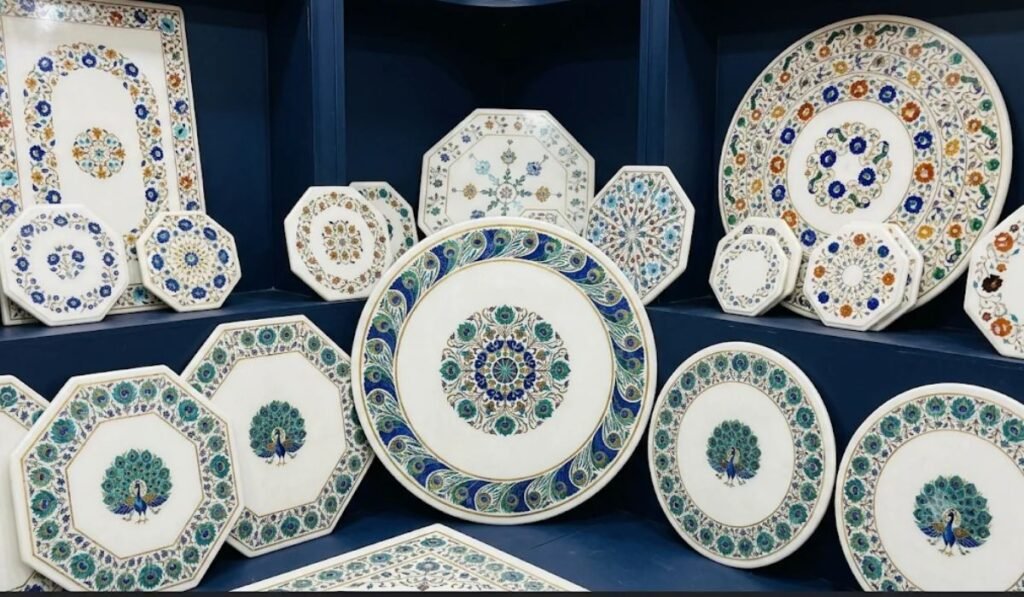
What is Parchin Kari? Parchin Kari is the art of inlaying coloured or semi-precious stones into a stone base, often in geometric or floral patterns. It is the local name for what Italians call pietra dura.
The Taj Mahal is its most famous showcase. Britannica notes that pietra dura and Arabic calligraphy are repeated throughout the complex. Stones used include carnelian, coral, agate, lapis lazuli, malachite and mother-of-pearl. A single petal is often built from several tiny pieces.
Today the technique appears on tables, photo frames, vases, trays, table tops, chess boards and jewellery boxes. Business Standard reports artisans working in Taj Ganj, Nai ki Mandi and Gokulpura.
If you want unhurried time at a workshop instead of a rushed stop, a Taj Mahal overnight tour with private cab leaves room for it between sightseeing.
How Marble Inlay Is Made
Practice varies by workshop, but the process generally follows these steps:
- Choose the marble. White Makrana marble is the primary material, prized for being soft yet durable.
- Draw the design. The artisan marks a floral or geometric pattern.
- Cut the stones. Stones are shaped into small pieces with a hand-operated machine.
- Carve the grooves. The marble is chiselled with a diamond-tipped chisel to make recesses.
- Fit the pieces. Each stone is set in place with specialised adhesive.
- Polish. The marble is buffed and polished once the inlay is complete.
Other Traditional Crafts of Agra
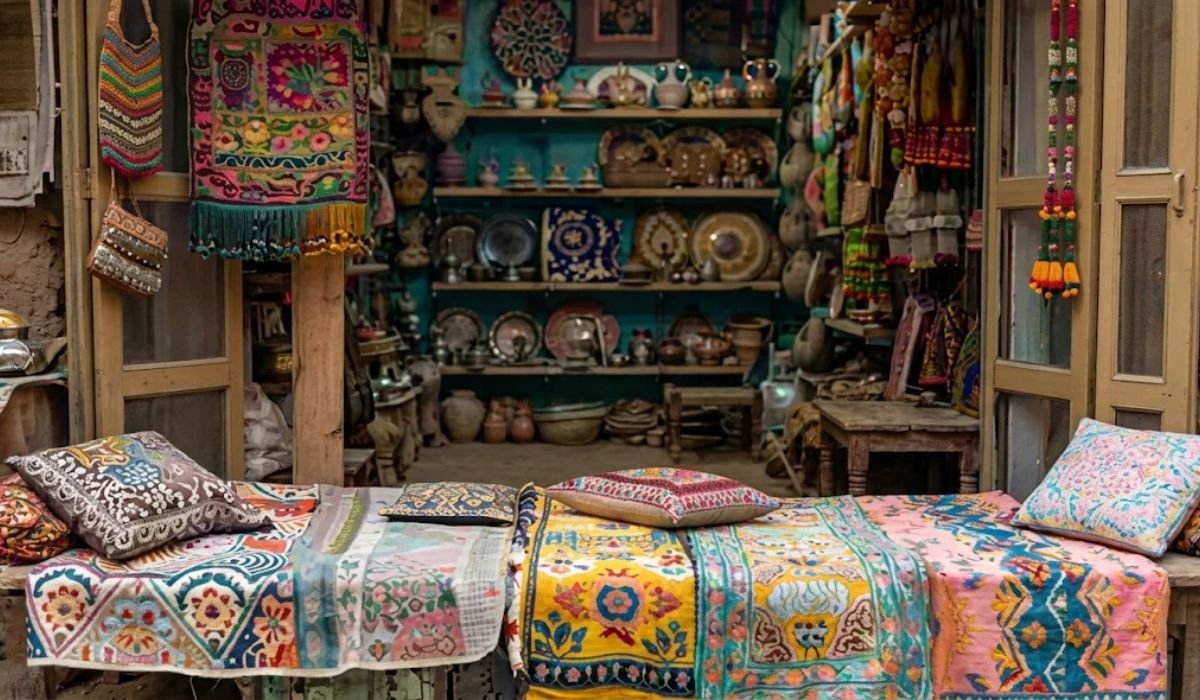
Zardozi. The name joins the Persian words for gold and embroidery. Incredible India describes it as a speciality of Agra once used to decorate the clothing of kings. It is also practised in Lucknow, Delhi, Hyderabad and other cities, so Agra is one centre among several.
Leather. The Press Information Bureau lists Agra Leather Footwear as GI-registered and an ODOP flagship product. Expect shoes, bags, belts and wallets. Check stitching and lining, and try footwear on.
Stone carving. Carved floral borders and lattice work follow the vocabulary of the monuments. At Agra Fort, where inlaid stones are missing, the carving beneath is visible in high relief.
Carpets. Take care with claims here. Uttar Pradesh’s main carpet hub is the Bhadohi–Mirzapur–Jaunpur region, so carpets are a regional product more than an Agra speciality.
Where to See and Buy Handicrafts in Agra
Incredible India lists Sadar Bazaar, Subhash Bazaar, Kinari Bazaar, Raja-ki-Mandi, Sanjay Place, Fatehabad Road, Munro Road and Shilphaat among the main shopping areas.
- Fatehabad Road: the hotel belt, with high-end hotels and marble stores.
- Sadar Bazaar: leather, garments, souvenirs and marble in a busy market.
- Kinari Bazaar: an old-city market near Jama Masjid, better for jewellery and fabrics than marble.
- Subhash Bazaar: known for silk products, especially sarees.
Market closing days differ between sources, so confirm hours locally. Also confirm that a workshop accepts visitors before you go.
How to Spot Authentic Handmade Work
No single sign proves a piece is handmade, so combine checks:
- Crisp edges and a smooth, even surface.
- Tight joins between stone and marble.
- Clear answers about materials, including whether stones are natural.
- A straight answer on which steps are done by hand.
- Prices compared across two or three shops.
- A receipt that describes the item.
Pay fairly and ask where a piece was made. The craft is under pressure: Business Standard reports low demand, poor earnings and fading interest among younger artisans.
FAQs : Traditional art and craft of Agra
What is Agra famous for besides the Taj Mahal?
Agra Fort, Fatehpur Sikri, Itmad-ud-Daulah’s tomb, marble inlay, leather footwear and zardozi.
What is the most famous traditional craft of Agra?
Marble inlay, known as Parchin Kari.
Is marble inlay still handmade in Agra?
Yes, many artisans still work by hand, though some tools are mechanised and not everything sold as handmade is.
What are the best handmade souvenirs from Agra?
Small marble inlay pieces, zardozi items, leather accessories and compact decorative objects.
Can tourists visit craft workshops in Agra?
Many welcome visitors, but access varies, so confirm in advance.