
Update 21-08-2026
This guide on Taj Mahal Timings was prepared by a travel team based in Agra that regularly assists domestic and international visitors exploring the Taj Mahal and other Mughal heritage sites.
Planning a visit to Agra? The Taj Mahal timings are based on sunrise and sunset, with the monument generally opening 30 minutes before sunrise and closing 30 minutes before sunset. The exact Taj Mahal opening time and Taj Mahal closing time therefore change throughout the year. The Taj Mahal is closed to general visitors every Friday.
In this guide, you will find complete information about Taj Mahal visiting hours, opening and closing times, seasonal timings, the Taj Mahal off day, Saturday timings, the best time to visit, night viewing and practical tips for planning your visit.
Timing is everything at the Taj Mahal. It determines how crowded your visit will be, how comfortable the weather feels, and whether your photographs capture that iconic reflection in clear morning light or a hazy, crowd-filled afternoon. If you are planning a day trip from Delhi, a Same Day Taj Mahal Tour by Car can help you plan your travel around the best visiting hours and make the most of your time in Agra. This guide gives you accurate, current information on Taj Mahal visiting hours along with practical local insight to help you plan your visit.
Taj Mahal Timings Today: Quick Reference
- Opens: 30 minutes before sunrise
- Closes: 30 minutes before sunset
- Closed: Every Friday
- Saturday: Open during regular visiting hours
- Best time: Around sunrise
- Winter: Approximately 6:30 AM to 5:30 PM
- Summer: Approximately 5:30 AM to 7:00 PM
- Night viewing: Available on selected full moon dates
Explore private and guided tour options for a smooth Taj Mahal visit.
Explore Taj Mahal Tours →What Are the Taj Mahal Timings?
The Taj Mahal timings generally begin 30 minutes before sunrise and end 30 minutes before sunset. The exact Taj Mahal visiting time changes throughout the year because sunrise and sunset occur at different times in Agra. In general, visitors can expect earlier opening hours during summer and later opening hours during winter. The monument remains closed to general visitors every Friday.
The Archaeological Survey of India (ASI) manages the site. They enforce the opening and closing time strictly. Visitors arriving even a few minutes after the gate closes are turned away without exception
Taj Mahal Opening Time and Closing Time — Detailed Breakdown
Taj Mahal Opening Time: What Time Does the Taj Mahal Open?
The Taj Mahal opening time varies by month because it is linked to the local sunrise time in Agra. During peak winter months like December and January, sunrise happens later, so the gates generally open around 6:30 AM. In summer, particularly from April to June, sunrise comes earlier and the Taj Mahal may open as early as 5:30 AM.
The exact opening time of Taj Mahal can therefore change throughout the year. If you want to enter around opening time, check the expected sunrise time for your specific travel date before planning your visit.
Local tip: The security check at the entry gates begins before the official opening time. If you want to be inside when the gates open, arrive at the gate around 30 to 40 minutes early. The first part of the morning can also feel quieter before larger crowds build up.
Taj Mahal Closing Time: When Does the Taj Mahal Close?
The Taj Mahal closing time follows the same seasonal pattern and is generally linked to sunset. During the longer summer days, particularly in May and June, visitors may be able to stay until around 7:00 PM. In December and January, when sunset comes earlier, the Taj Mahal closing time can be around 5:30 PM.
Because sunset times change throughout the year, visitors should check the expected timing for their specific travel date. It is also better not to arrive close to closing time, as security checks and the walk through the complex can significantly reduce the time available for sightseeing.
If you want enough time to explore the gardens, take photographs and visit the main mausoleum, plan to arrive well before the final part of the visiting day.
Taj Mahal Closing Day: What Is the Taj Mahal Off Day?
The Taj Mahal closing day is Friday. The monument remains closed to general tourists every Friday, making Friday the regular Taj Mahal off day. If your Agra visit falls on a Friday, plan your itinerary around other attractions and schedule your Taj Mahal visit for another day.
Other closures to be aware of: The Taj Mahal may close on specific national security event days at short notice. These are rare but do happen. Checking ASI notifications a day before your visit is recommended.
What Can You Do in Agra on Friday Instead?
What Can You Do in Agra on Friday Instead?
If your visit to Agra falls on a Friday, you can use the day to explore other parts of the city and plan your Taj Mahal visit for the following day. Although the Taj Mahal is closed to general visitors on Friday, several important attractions in Agra can still be included in your sightseeing plan.
Agra Fort is a good choice for visitors interested in Mughal history and architecture. You can explore its palaces, courtyards and historic structures while learning more about the Mughal era.
Itmad-ud-Daulah’s Tomb, often called the Baby Taj, is another worthwhile stop. Its detailed marble work and peaceful setting make it a good addition to an Agra sightseeing day.
For views of the Taj Mahal from across the Yamuna River, consider visiting Mehtab Bagh. It can be especially appealing for visitors interested in photography and a different perspective of the monument.
You can also use Friday to explore local markets, enjoy Agra’s food or visit other historic sites before planning your Taj Mahal visit on Saturday or another available day. This way, a Friday closure does not have to disrupt your entire Agra itinerary.
Best Time to Visit the Taj Mahal
Winter (October to February)
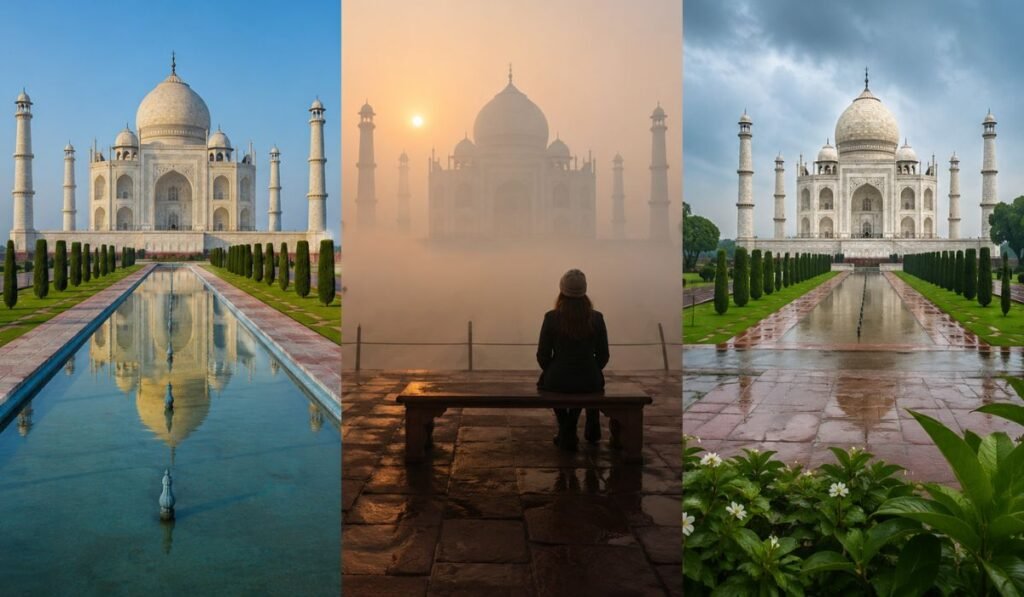
Winter is the most popular season to visit Agra. The weather is cooler, humidity is low, and the marble looks its most vivid under clear skies. This is also the season most international tourists choose, which means the Taj Mahal can be significantly crowded between November and January.
One thing most guides do not mention: winter fog. From mid-December through early February, dense fog often blankets Agra in the early morning hours. On heavily fogged days, the Taj Mahal becomes almost invisible from the main gate. Experienced local visitors plan their visit for late morning on foggy days, or come prepared to wait for the fog to lift. Fog-covered Taj Mahal photographs have their own dramatic beauty, but if you want the clean reflection shot, check the Agra weather forecast the night before.
Summer (March to June)
Summer in Agra is intense. May temperatures regularly exceed 45 degrees Celsius. The Taj Mahal visiting hours in summer begin earlier due to earlier sunrises, which is an advantage. A sunrise visit in summer — where you enter at 5:30 AM and leave before 8:30 AM — is genuinely comfortable. Anything after that becomes difficult to manage in the heat.
For travellers who want to experience the monument during the best morning hours, our 1 Day Taj Mahal Tour by Superfast Train is designed around early arrival times.
Carry water, wear light-coloured clothing, and bring sunglasses. The white marble amplifies the heat and the glare considerably.
Monsoon (July to September)
Monsoon is an underrated time to visit. Crowds drop significantly, the gardens are lush and green, and the air has a freshness not found at other times of year. The Yamuna River behind the Taj Mahal fills up, creating reflections that summer visitors never see.
Rain can be unpredictable. Some visitors get a clear morning followed by afternoon showers. Others experience light cloud cover that softens the light beautifully for photography. If your travel dates fall in monsoon and you have flexibility, this is worth considering.
Local Agra Tips Most Tourists Never Hear
Based on local observations gathered from years of assisting visitors at the Taj Mahal, here are insights that rarely appear in standard travel guides:
- Weekends (Saturday and Sunday) draw large numbers of domestic tourists. School holiday periods — particularly May–June and October–November — see massive school group visits that start arriving from 9:00 AM.
- The queue at the East Gate is almost always shorter than the queue at the South Gate, which most tourists default to because it appears first on Google Maps.
- Security check lines can add 20 to 40 minutes to your entry time during peak hours. Factor this into your Taj Mahal visit timing.
- Photography inside is permitted, but tripods are not allowed without prior permission from ASI.
- The inner mausoleum chamber has a strict no-photography rule. Enforcement is inconsistent but the rule exists.
- Shoe covers are provided free at the marble plinth base. Do not pay touts who offer them outside the gate — they are complimentary inside.
When Is the Taj Mahal Most Crowded?
Here is a practical crowd level guide based on ground observation across different times of day:
| Time Window | Crowd Level |
|---|---|
| 6:00 AM – 8:00 AM | Low ✓ Best |
| 8:00 AM – 11:00 AM | High |
| 11:00 AM – 3:00 PM | Very High – Avoid |
| 3:00 PM – Sunset | Moderate |
The single most effective thing any visitor can do is arrive at or before the gate opening time. The first 90 minutes inside the Taj Mahal complex offer a completely different experience from what most tourists encounter.
Which Entry Gate Should You Use?
The Taj Mahal has three entry gates: East Gate, West Gate, and South Gate. Each leads to the same complex, but the visitor experience differs.
- East Gate: Generally the least crowded. Recommended for most visitors. Parking is available nearby and the approach road is quieter.
- West Gate: Popular with tour groups arriving from Agra city. Can be busy but the queue moves steadily.
- South Gate: Located closest to the Taj Mahal Ganj area. Often the most crowded due to proximity to budget hotels and backpacker areas. Best avoided during peak hours.
For a sunrise visit, the East Gate is the recommended choice. The entry process is smoother, and you lose less time in the security queue.
Taj Mahal Night Viewing Timings

While regular Taj Mahal timings follow a sunrise-to-sunset schedule, night viewing offers a completely different experience. Special night visits are permitted on the full moon night and the two nights before and after each full moon. However, night viewing is not available on Fridays or during the month of Ramadan.
Night viewing is strictly limited to 400 visitors per night and must be booked in advance through the ASI-authorised ticketing system. Entry is typically available between 8:30 PM and 12:30 AM, with visitors admitted in batches of 50 for 30-minute viewing sessions.
Seeing the Taj Mahal under moonlight is unlike any daytime visit. The white marble takes on a soft glow, and the reduced visitor numbers create a quieter, more atmospheric experience. Many travellers consider it one of the most memorable ways to see the monument. Because tickets are limited and demand is high during peak tourism months, advance booking is strongly recommended.
How Long Should You Spend at the Taj Mahal?
Most visitors spend between 2 and 3 hours inside the Taj Mahal complex. This is generally sufficient to walk the gardens, reach the main mausoleum, view the interior, and explore the mosque and guest house on either side of the main structure.
If you are a keen photographer or plan to explore Mehtab Bagh (the garden on the opposite bank of the Yamuna that offers a rear view of the Taj), budget an additional hour to 90 minutes.
What most guides skip: the best photograph of the Taj Mahal from inside the complex is not taken from directly in front. It is taken from the far end of the central pool, with the reflection in the foreground. Walk all the way to the main gate side and shoot back toward the mausoleum.
Common Mistakes Visitors Make at the Taj Mahal
- Arriving at 10:00 AM or later and wondering why the crowd is overwhelming
- Planning a Friday visit without checking the closure schedule
- Not booking tickets in advance and losing time at the ticket window
- Ignoring weather conditions — particularly fog in winter and heat in summer
- Using the South Gate without realising the queue can be significantly longer
- Forgetting to check if there is a school holiday or national holiday that week
Before travelling, review our complete Taj Mahal Tickets Guide to understand ticket categories, pricing, and booking options.
Suggested Itinerary
If You Have Half a Day
- 5:30 AM – Depart hotel toward East Gate
- 6:00 AM – Clear security, enter complex at gate opening
- 6:00 AM to 8:30 AM – Full Taj Mahal visit at sunrise with minimal crowds
- 9:00 AM – Exit, breakfast at a local restaurant in the Taj Ganj area
If You Have One Full Day
- 6:00 AM – Taj Mahal sunrise visit
- 9:00 AM – Breakfast and rest at hotel
- 11:00 AM – Visit Agra Fort (2 km from Taj Mahal)
- 1:30 PM – Lunch
- 3:30 PM – Visit Baby Taj (Itmad-ud-Daulah)
- 5:30 PM – Mehtab Bagh for rear-view sunset photographs
Places to Visit After the Taj Mahal
Once you have completed your Taj Mahal visit, Agra offers several other UNESCO and heritage sites worth exploring:
- Agra Fort: A massive Mughal fortification 2 km from the Taj Mahal, offering views back toward the monument.
- Mehtab Bagh: The moonlight garden across the Yamuna. The only place that gives you a full rear view of the Taj.
- Baby Taj (Itmad-ud-Daulah): Often called the draft for the Taj Mahal. Smaller, more intricate, and far less crowded.
- Fatehpur Sikri: A 16th-century ghost city 40 km from Agra, easily added to a day trip.
Frequently Asked Questions
What are the Taj Mahal timings?
The Taj Mahal opens 30 minutes before sunrise and closes 30 minutes before sunset every day except Friday.
What time does the Taj Mahal open?
The Taj Mahal opening time is approximately 6:00 AM to 6:30 AM depending on the season and the local sunrise time.
What time does the Taj Mahal close?
The Taj Mahal closing time is approximately 5:30 PM in winter and 7:00 PM in summer.
Is the Taj Mahal open on Friday?
No. The Taj Mahal is closed every Friday for the entire day.
What is the best time to visit the Taj Mahal?
Sunrise. The first 90 minutes after the gates open offer the lowest crowd levels, the best light for photography, and the most comfortable temperature.
Can I visit the Taj Mahal at night?
Yes, but only on full moon nights and the two nights before and after. Tickets are limited to 400 visitors and must be booked in advance.
How long does a Taj Mahal visit take?
Most visitors spend 2 to 3 hours. Photographers and thorough explorers may prefer 3 to 4 hours.
Which gate should I use to enter the Taj Mahal?
The East Gate is recommended for most visitors due to shorter queues and easier parking.
Are tickets required for the Taj Mahal?
Yes. Tickets are mandatory and can be purchased online through the ASI portal or at the gate counters. Online booking is strongly recommended to save time.
Is the Taj Mahal open on public holidays?
Generally yes, except on specific high-security national events when ASI may issue short-notice closures. Always check ASI official notices before travel.
Is the Taj Mahal safe for tourists?
Yes, the Taj Mahal is considered one of the safest tourist attractions in India, with dedicated tourist police and extensive security screening. Read our detailed guide on Is It Safe to Visit Taj Mahal for practical safety tips.